Category: State Licensing Guides

How to start and license a non-medical home care agency, state by state.

  • How to Start a Home Care Agency in Pennsylvania (2026)

    Last verified: October 2026. Rules and fees change, so confirm every figure with the Pennsylvania Department of Health before you file.

    Pennsylvania has one of the lowest licensing fees in the country, but it licenses more than most states do: even companion-only businesses need a license. This guide covers what it takes to open a non-medical home care agency in Pennsylvania, the steps in order, what it costs, and what your caregivers need.

    Quick facts: Pennsylvania home care licensing

    License nameHome Care Agency (you employ caregivers) or Home Care Registry (you refer independent caregivers)
    Issued byPennsylvania Department of Health, Division of Home Health
    Governing lawHealth Care Facilities Act (35 P.S. §448.101 et seq.); 28 Pa. Code Chapter 611
    License fee$100 initial, $100 renewal, nonrefundable
    Apply throughThe DOH SAIS online portal
    InspectionOn-site, before the license is issued
    Companion-only license?Yes, companionship counts as home care

    Do you need a license for home care in Pennsylvania?

    Yes, for almost any paid in-home help. Chapter 611 defines home care services to include personal care, help with household tasks and companionship, so a companion-only business still needs a license. You choose between two license types:

    • Home Care Agency: you hire caregivers as employees and supervise them.
    • Home Care Registry: you refer independent caregivers to clients.

    One business can hold both. Each physical location needs its own license.

    Step-by-step: how to open a home care agency in Pennsylvania

    1. Form your business and get owner criminal history reports; the rules require them on file.
    2. Write your policies, consumer notices (including the direct care worker status notice) and your caregiver competency program.
    3. Apply online in the DOH SAIS portal. Paper and emailed applications are no longer accepted.
    4. Mail the $100 fee by check, payable to the Commonwealth of Pennsylvania.
    5. Pass the on-site inspection. If you run from home, DOH inspects your home office.
    6. Submit a plan of correction if DOH finds anything, then receive your license.
    7. Enroll in Medicaid (optional) once licensed.

    Pennsylvania has no certificate of need and no moratorium on new home care agencies.

    How much does it cost?

    • DOH license: $100, and $100 at each renewal (renewal due at least 60 days before expiration).
    • Business formation, insurance, background checks and TB screening for staff.
    • Changing your administrator later requires a resume and a background check under a year old.

    Budget separately for insurance, payroll for your first caregivers before clients pay, software, and marketing. Licensing is rarely the biggest line. See what it really costs to start a home care agency.

    Caregiver requirements in Pennsylvania

    • Before assignment, each caregiver must hold a PA nursing license, pass your competency exam, or complete approved training (your program, a home health aide program, a CNA program, or Medicaid waiver training).
    • No minimum hours are set, but training must cover topics like confidentiality, infection control, emergencies and abuse reporting, plus bathing, transfers and toileting for personal care.
    • Competency is reviewed every year.
    • Two references, a PA State Police background check (FBI check if they have lived in PA under 2 years) and TB screening before client contact, then yearly.
    • Provisional hiring is allowed while checks are pending, with monitoring.

    How long does it take?

    Plan on roughly 3 to 6 months, driven mostly by how quickly DOH schedules your inspection.

    Medicaid in Pennsylvania

    Medicaid personal assistance for older adults and adults with physical disabilities runs mostly through Community HealthChoices, a managed care program. The path is your DOH license, then Pennsylvania Medicaid provider enrollment, then contracts with the Community HealthChoices plans.

    Comparing states? See the home care license requirements for every state.

    Want the full playbook?

    I built and run a licensed home care agency in California. The licensing steps differ state to state, but getting clients, hiring good caregivers and managing cash flow work the same way in Pennsylvania. The Home Care Agency Blueprint covers that side in 49 lessons. You can see the syllabus, start with the $29.99 Startup Workbook, or book a free call to map out your Pennsylvania launch.

    FAQ

    Do I need a license for companion care in Pennsylvania?

    Yes. Pennsylvania counts companionship as home care, so companion-only agencies need a Home Care Agency or Registry license.

    What is the difference between a home care agency and a registry?

    An agency employs caregivers and handles payroll, taxes and supervision. A registry refers independent caregivers to clients. Both are licensed under the same chapter.

    Do I need an office?

    No specific office type is required. If you operate from home, the inspection happens at your home.
    Sources

  • How to Start a Home Care Agency in North Carolina (2026 Licensing Guide)

    How to Start a Home Care Agency in North Carolina (2026 Licensing Guide)

    Last verified: September 2026. Rules and fees change, so confirm every figure with the NC Division of Health Service Regulation before you file.

    North Carolina has a fast-growing senior population and a reasonable license fee, but it asks more of your leadership team than most states: a qualified agency director, an RN on call whenever aides are working, and state-approved training before you apply. This guide covers what it takes to open a non-medical home care agency in North Carolina in 2026, with a source for each rule.

    Quick facts: North Carolina home care licensing

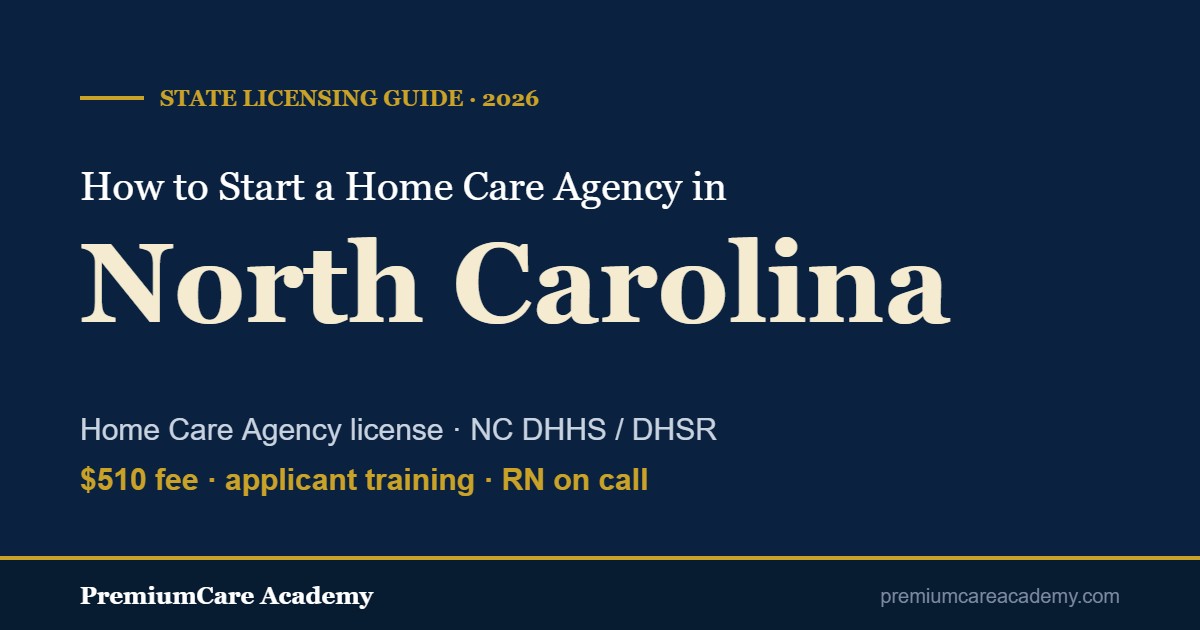
    License nameHome Care Agency license
    Issued byNC DHHS, Division of Health Service Regulation (DHSR), Acute and Home Care Licensure and Certification Section
    Governing lawG.S. 131E-135 to 131E-142; 10A NCAC 13J
    License fee$510, nonrefundable
    Renewal$510 every year; all licenses expire December 31
    Certificate of NeedNot required for a licensed-only (non-Medicare) agency
    Required before applyingDHSR-approved licensure applicant training

    Do you need a license for home care in North Carolina?

    Yes. G.S. 131E-138 says no one may operate a home care agency or a “home assistance services provider” without a license.

    • In-home aide services with hands-on care make you a home care agency.
    • Companion, sitter, respite or homemaker services with no hands-on care were given their own category, “home assistance services provider,” by Session Law 2023-150. Those providers still need a license, must carry liability insurance, must tell clients they give no hands-on care, and may not bill insurance.

    As of September 2026, DHSR’s application form still lists companion/sitter/respite as a home care license category, and we couldn’t find a separate application for the new home assistance category. If you plan to offer companion care only, call DHSR (919-855-4620) before you apply. Don’t assume companion-only care is license-free in North Carolina.

    Step-by-step: how to get a home care license in NC

    1. Complete DHSR-approved licensure applicant training. It’s required unless you’ve previously owned or operated a home care agency. DHSR lists approved trainers.
    2. Mail the application (DHSR-4204), one per site, with the $510 fee and proof of training to DHSR in Raleigh.
    3. Submit policies, procedures and personnel records when DHSR asks, using the Initial Home Care Survey Checklist.
    4. Initial survey. DHSR reviews your documents, then emails an approval letter and license access.
    5. Finish within 12 months of your application date.

    Who you need on your team

    • Agency director: a health care practitioner, or 2+ years of supervisory or management experience in home care or a similar licensed provider, or a bachelor’s degree in health, business or public administration plus 1 year of that experience.
    • RN: an agency with in-home aides must have an RN available for supervision whenever aides are working. Only an RN, not an LPN, can do assessments and supervisory visits.
    • Premises: an office with the license posted and a sign on the public door.

    Your in-home aide service area is limited to your county, neighboring counties, or 90 minutes’ drive, whichever is larger.

    How much does it cost?

    • Initial license: $510
    • Annual renewal: $510 (renew before December 31)
    • Change of ownership: $510
    • Each site needs its own license

    Also budget for the applicant training course, your RN, and insurance. The applicant training cost varies by provider.

    Caregiver requirements in North Carolina

    • Criminal background check within 5 business days of a conditional offer, plus a national fingerprint check if the person has lived in NC less than 5 years (G.S. 131E-265).
    • Health Care Personnel Registry check before hire. You can’t hire anyone with a substantiated finding.
    • Nurse Aide Registry listing for aides whose clients need extensive assistance. Aides giving limited assistance need an RN to verify their core personal-care skills.
    • Supervision: RN supervisory visits every 90 days, plus once a year with the aide present.
    • Health: baseline TB skin test for hands-on staff, Hepatitis B vaccination or a signed declination, and annual bloodborne pathogen training.

    How long does it take?

    DHSR says it’s “not possible to establish specific time frames.” The only fixed limit is that you must finish within 12 months of applying.

    Medicaid in North Carolina

    Medicaid Personal Care Services (Clinical Coverage Policy 3L, amended January 1, 2026) require a DHSR-licensed home care agency in the counties you serve. You also enroll in NCTracks and use the Sandata electronic visit verification system.

    Starting in a different state? Compare home care licensing by state.

    Want the full playbook?

    I built and run a licensed home care agency in California. North Carolina’s licensing is its own process, but getting clients, hiring caregivers and managing cash flow work the same way everywhere. The Home Care Agency Blueprint covers that side in 49 lessons. You can see the syllabus or start with the $29.99 Startup Workbook.

    FAQ

    How much is a home care license in NC?

    $510 to apply and $510 each year to renew.

    Do I need a Certificate of Need?

    Only if you want to become a Medicare-certified home health agency. A licensed-only home care agency doesn’t need one.

    Do I need to be a nurse to own a home care agency in NC?

    No, but your agency must have an RN available whenever in-home aides are working, and your director must meet the experience or education standard.

    Sources

    This article is general information, not legal advice. Confirm current requirements with DHSR or a licensing attorney before you apply.

    Want help getting licensed in North Carolina?

    We write the policy binder North Carolina asks for, prepare your home care license application for you to sign, and answer correction letters until the state decides. The full PremiumCare Academy course is included.

    See my North Carolina price or book a free 30-minute call

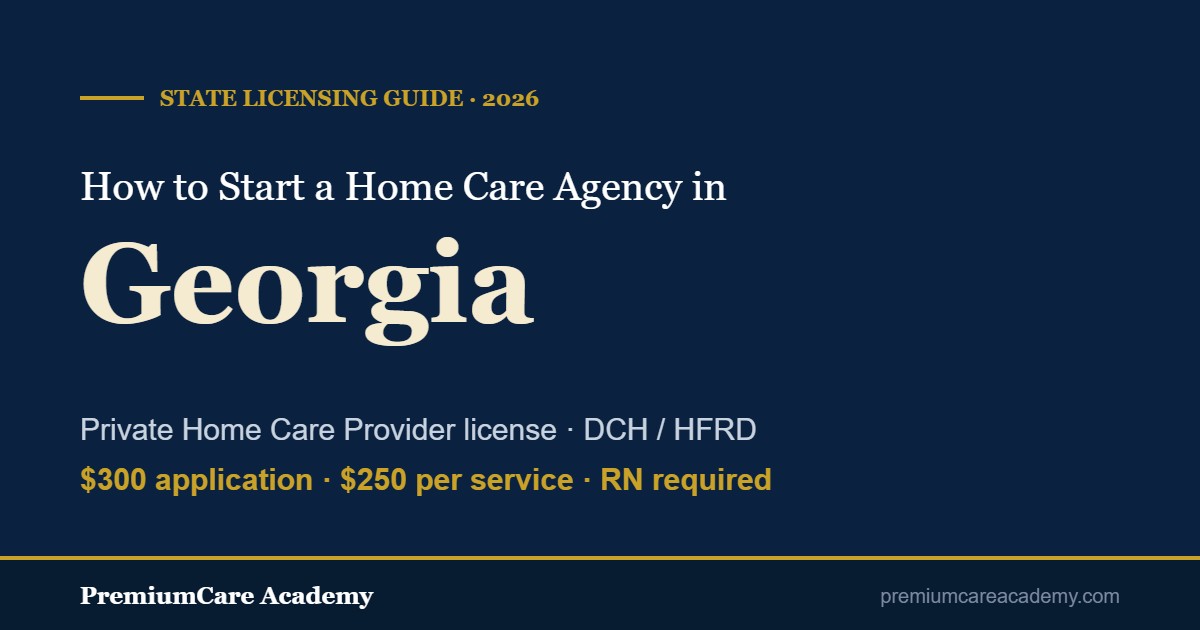
  • How to Start a Home Care Agency in Georgia (2026 PHCP License Guide)

    How to Start a Home Care Agency in Georgia (2026 PHCP License Guide)

    Last verified: September 2026. Rules and fees change, so confirm every figure with the Georgia Department of Community Health before you file.

    Georgia’s home care license is one of the more affordable in the country, but it has a catch many first-time owners miss: you need a registered nurse on the application even if you only plan to offer companion care. This guide covers what it takes to open a non-medical home care agency in Georgia in 2026, with a source for each rule.

    Quick facts: Georgia home care licensing

    License namePrivate Home Care Provider (PHCP) license
    Issued byGeorgia Department of Community Health (DCH), Healthcare Facility Regulation Division (HFRD)
    Governing lawO.C.G.A. §31-7-300 to §31-7-308; Rules Ch. 111-8-65
    Application fee$300
    Annual license fee$250 per service (companion/sitter, personal care, nursing)
    Apply throughGAHLES online portal
    Initial reviewAbout 30 business days

    Do you need a license for home care in Georgia?

    Yes. One PHCP license covers three service types: companion or sitter tasks, personal care tasks and nursing services. You pay $250 a year for each service you’re licensed to provide. No agency may operate without a license or provisional license (Rule 111-8-65-.05).

    Step-by-step: how to get a PHCP license

    1. Register your business with the Georgia Secretary of State and get a local business license. Names and addresses must match your application.
    2. Fingerprint background checks through GCHEXS for every owner with 10% or more, and your administrator. You need a “satisfactory determination” letter dated within the last 12 months. Expect 10 to 15 business days.
    3. Line up an RN. DCH’s checklist says “An RN is required for the initial application,” including for companion-only agencies.
    4. Prepare your administrator’s file: qualifications, job description, GCHEXS letter and proof of orientation training.
    5. Submit in GAHLES with the notarized Personal Identification Affidavit, notarized Affidavit of Compliance, electronic owner form and fees.
    6. Provisional license. After approval, DCH issues a provisional license valid for 3 months. In that time you must become operational and admit at least 3 clients.
    7. Request your initial survey by emailing HFRD. Re-licensure surveys happen about every 18 to 24 months.

    How much does it cost?

    • Application fee: $300
    • Annual license fee: $250 per service, up to $750 for all three
    • Change of ownership, name change or a service-level change needing a site visit: $300 each
    • Accredited providers get a 25% discount

    The state fees are low. Your real costs are the RN, payroll, and insurance. Georgia’s rules don’t set a liability insurance minimum, but you’ll want coverage anyway.

    Caregiver requirements in Georgia

    • Personal care aides need one of: CNA training and competency evaluation, a DCH-recognized competency exam, a DCH-approved credentialing program, or a 40-hour training program (20 hours before serving clients, the rest within 6 months).
    • Companions and sitters must show competency in topics such as elder needs, meals, home safety, emergencies and infection control.
    • All staff: orientation, 8 hours of training a year, and TB screening at hire and every year after.
    • Supervision: supervisory home visits at least every 92 days for personal care clients and every 122 days for companion/sitter clients.
    • Background checks through GCHEXS for anyone with direct client access.

    How long does it take?

    DCH’s current checklist says the initial review takes about 30 business days from submission. Add 10 to 15 business days for GCHEXS fingerprints, then the 3-month provisional period to admit your first 3 clients before the survey.

    Medicaid in Georgia

    A licensed PHCP can apply to provide personal support services under Georgia’s Elderly & Disabled Waiver (CCSP and SOURCE), ICWP, and the NOW and COMP waivers. Each has its own enrollment process separate from licensing. Note that the 2026 CMS moratorium on new Medicare home health enrollment does not apply to non-medical PHCPs.

    Starting in a different state? Compare home care licensing by state.

    Want the full playbook?

    I built and run a licensed home care agency in California. Georgia’s licensing is its own process, but that 3-client requirement means you need a plan for finding clients before you’re fully licensed. The Home Care Agency Blueprint covers client acquisition, hiring and cash flow in 49 lessons. You can see the syllabus or start with the $29.99 Startup Workbook.

    FAQ

    Do I need a nurse to start a companion care agency in Georgia?

    According to DCH’s current application checklist, yes: an RN is required for the initial application regardless of service type.

    How much is a home care license in Georgia?

    $300 to apply, then $250 per year for each service type you provide.

    How many clients do I need before my survey?

    At least 3, admitted during the 3-month provisional license period.

    Sources

    This article is general information, not legal advice. Confirm current requirements with DCH or a licensing attorney before you apply.

    Want help getting licensed in Georgia?

    We write the policy binder Georgia asks for, prepare your Private Home Care Provider license application for you to sign, and answer correction letters until the state decides. The full PremiumCare Academy course is included.

    See my Georgia price or book a free 30-minute call

  • How to Start a Home Care Agency in Texas (2026 PAS License Guide)

    How to Start a Home Care Agency in Texas (2026 PAS License Guide)

    Last verified: September 2026. Rules and fees change, so confirm every figure with Texas Health and Human Services (HHSC) before you file.

    Texas is one of the biggest markets in the country for private-pay home care, and its licensing system is more structured than most. This guide covers what it takes to open a non-medical home care agency in Texas in 2026, with a link to the official rule behind each step.

    Quick facts: Texas home care licensing

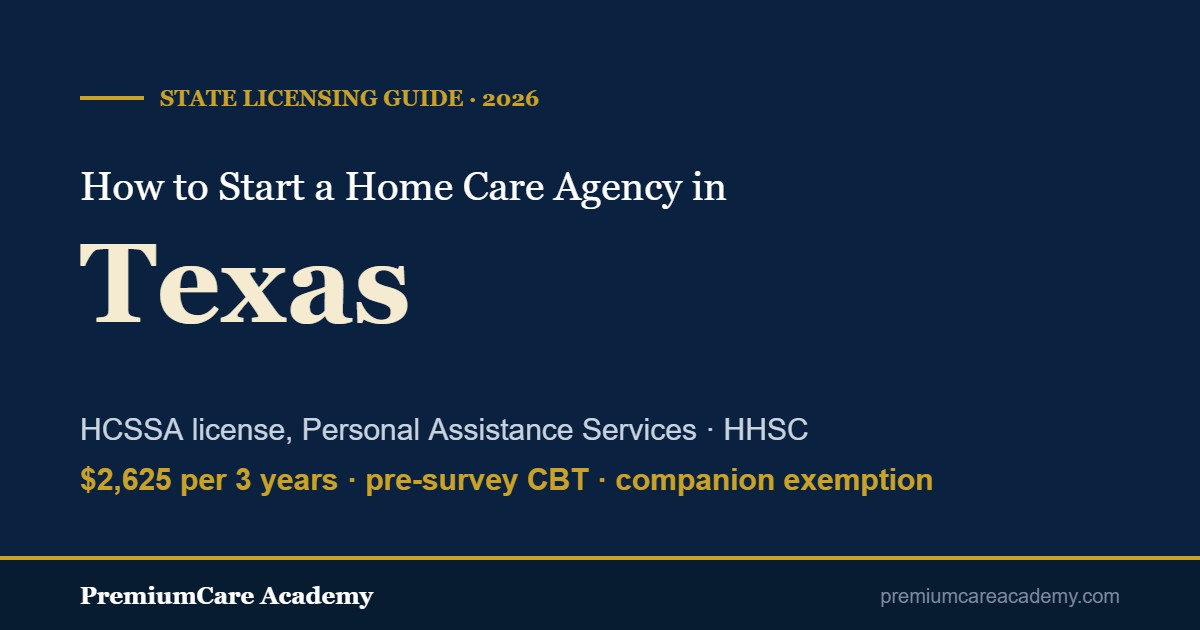
    License nameHome and Community Support Services Agency (HCSSA) license, Personal Assistance Services (PAS) category
    Issued byTexas HHSC, Long-Term Care Regulation, HCSSA Licensing
    Governing lawHealth & Safety Code Ch. 142; 26 TAC Chapter 558
    License fee$2,625, nonrefundable
    License term3 years (renewal $2,625)
    Required trainingPre-survey computer-based training (CBT), Modules 1–3, 80% to pass
    Apply throughTULIP online portal

    Do you need a license for home care in Texas?

    It depends on what your caregivers do:

    • Hands-on personal care (help with bathing, dressing, toileting, eating and other activities of daily living) requires an HCSSA license in the Personal Assistance Services category, for every place of business.
    • Companion-only services are exempt. Texas law excludes “sitter-companion services or chore or household services that do not involve personal care, health, or health-related services” (Health & Safety Code §142.003(a)(15)).

    Most agencies that want to grow end up needing the PAS license, because families’ needs move from companionship to hands-on care. Also note: since September 1, 2025 (HB 2510), providing personal assistance services to an assisted living resident without the required license is a Class A misdemeanor.

    Step-by-step: how to get a PAS license in Texas

    1. Register your business with the Texas Secretary of State and Comptroller. HHSC checks that you are in good standing.
    2. Choose a qualified administrator and alternate. For a PAS-only agency, each needs a high school diploma or GED plus 1 year of experience caring for people with functional disabilities, or 2 years of full-time college in a health-related field. No RN is required for PAS only.
    3. Pass the pre-survey CBT. The administrator and alternate complete Modules 1 (Introduction), 2 (General Standards) and 3 (PAS), score at least 80%, and upload the signed certificates.
    4. Apply in TULIP and pay the $2,625 fee. HHSC doesn’t review the application until the payment shows as received.
    5. Get licensed, then admit a client. Within 6 months of the license date you must admit at least one client and file HHSC Form 2020 (Notification of Readiness for Initial Survey).
    6. Pass the unannounced initial survey. After that, HHSC resurveys within 18 months and then at least every 36 months.

    Administrators also need 8 clock hours of training before designation and 24 hours in their first 12 months (26 TAC §558.259). The CBT does not count toward those hours.

    How much does it cost?

    • Initial HCSSA license: $2,625
    • Each branch office: $2,625
    • Renewal (3-year license): $2,625, with a late fee of half the renewal fee

    Texas rules don’t set a liability insurance or bond minimum for PAS agencies, but they do require enough funds to operate and meet payroll (26 TAC §558.252). In practice, you’ll want liability and workers’ comp coverage anyway, and most referral sources and managed care plans will ask for it.

    Caregiver requirements in Texas

    • Criminal history check under Health & Safety Code Chapter 250. Certain convictions bar employment.
    • Registry checks of the Nurse Aide Registry and the Employee Misconduct Registry before hire or first client contact, then every 12 months.
    • Age and competency: aides generally must be 18 or older and show competency in the tasks assigned. Texas sets no fixed number of training hours for PAS aides.

    How long does it take?

    Under 26 TAC §558.31, HHSC has up to 45 days to decide whether your application is complete and up to 45 more days to issue the license, so about 90 days by rule. You then have 6 months to admit your first client and request the survey.

    Medicaid in Texas

    A licensed PAS agency can contract with HHSC for programs such as Primary Home Care and Community Attendant Services, and can join STAR+PLUS managed care networks through each health plan’s credentialing. Contracting is optional and separate from licensing.

    Starting in a different state? Compare home care licensing by state.

    Want the full playbook?

    I built and run a licensed home care agency in California. The licensing steps differ state to state, but getting clients, hiring good caregivers and managing cash flow work the same way in Texas. The Home Care Agency Blueprint covers that side in 49 lessons. You can see the syllabus or start with the $29.99 Startup Workbook.

    FAQ

    Do I need a license for companion care in Texas?

    Not if your services are strictly companion, sitter, chore or household help with no personal care. Once caregivers help with bathing, dressing or other hands-on care, you need a PAS license.

    Do I need to be a nurse to open a PAS agency?

    No. A PAS-only agency doesn’t need an RN. The administrator must meet the experience or education standard in 26 TAC §558.244.

    Can I serve clients while my application is pending?

    No. You may not provide licensed services until the license is issued.

    Sources

    This article is general information, not legal advice. Confirm current requirements with HHSC or a licensing attorney before you apply.

    Want help getting licensed in Texas?

    We write the policy binder Texas asks for, prepare your HCSSA PAS license application for you to sign, and answer correction letters until the state decides. The full PremiumCare Academy course is included.

    See my Texas price or book a free 30-minute call

  • How to Start a Home Care Agency in Florida (2026 Licensing Guide)

    How to Start a Home Care Agency in Florida (2026 Licensing Guide)

    Last verified: September 2026. Rules and fees change, so confirm every figure with Florida’s Agency for Health Care Administration (AHCA) before you file.

    Florida has more seniors per capita than almost any other state, which makes it a strong home care market. It also has the most confusing licensing setup of any state I’ve looked at, because what you’re allowed to do depends on which of three AHCA credentials you hold. This guide explains the options for a non-medical home care agency in 2026, with a source for each rule.

    Quick facts: Florida home care licensing

    OptionWhat it allowsFee (per 2 years)
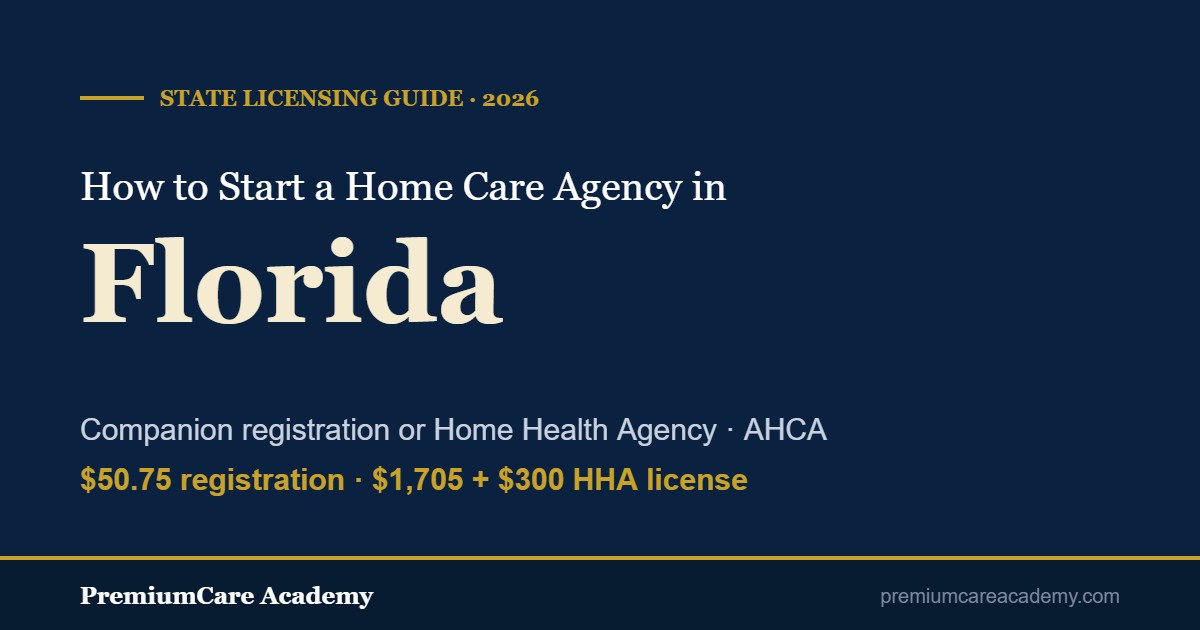
    Homemaker & Companion Services registrationCompanionship, housekeeping, meals, errands, shopping. No hands-on personal care.$50.75
    Home Health Agency (HHA) licensePersonal care (bathing, dressing, eating, transfers) through employed aides and CNAs$1,705 + $300 assessment
    Nurse Registry licenseRefers independent-contractor nurses, CNAs, aides, companions and homemakers$2,000

    All three are regulated by AHCA under Chapter 400, Part III and Chapter 408, Part II of the Florida Statutes, and renew every 2 years.

    Which one do you need?

    • Companion and homemaker only? The HCS registration is enough. Florida law says companions and homemakers “may not provide hands-on personal care” (s. 400.462).
    • Want to help clients bathe, dress or move? You need a Home Health Agency license (or a Nurse Registry). A non-skilled HHA that uses only aides, CNAs, homemakers and companions does not need accreditation or a Director of Nursing.

    Many owners start with the registration to get moving, then find that most families eventually need hands-on help. Decide up front which business you’re building.

    Step-by-step: getting licensed in Florida

    1. Form your entity with the Florida Division of Corporations and register any fictitious name. The name and address on your AHCA application must match.
    2. Level 2 background screening for controlling owners, the administrator and the financial officer, started through the AHCA Clearinghouse and done at a LiveScan provider.
    3. Apply in the AHCA Online Licensing System and pay within 30 days of creating the application, or it expires.
    4. Answer AHCA’s questions within 21 days, or the application is withdrawn and the fee is forfeited.
    5. Inspection: the HCS registration has no initial inspection. A Home Health Agency must pass an inspection before licensure.

    Extra requirements for a Home Health Agency license

    • A signed business plan and list of services
    • Two years of projected financial statements compiled and signed by a CPA
    • Proof of funds covering at least 3 months of average projected expenses
    • Malpractice and general liability insurance of at least $250,000 per claim each
    • Proof you can occupy your office, plus local zoning approval
    • An administrator who is a physician, PA or RN, or has at least 1 year of supervisory experience in home health or a licensed facility, plus an alternate administrator

    Caregiver requirements in Florida

    • Level 2 background screening for HHA, nurse registry and companion/homemaker staff.
    • Dementia training: basic information at hire, a free 1-hour Department of Elder Affairs course within 30 days for staff with regular client contact, and 2 more hours within 7 months for staff who provide personal care.
    • Home health aides at an HHA: at least 40 hours of training or passing AHCA’s competency test (CNAs also qualify), current CPR, and a one-time HIV/AIDS course within 30 days of hire.

    How long does it take?

    AHCA must approve or deny within 60 days of receiving a complete application. Home Health Agency applications take longer in practice because of the financial documents and inspection.

    Medicaid in Florida

    Florida pays for homemaker, companion and personal care services through the Statewide Medicaid Managed Care Long-Term Care program. Those services are delivered through the managed care plans, so agencies generally work through plan contracts.

    Starting in a different state? Compare home care licensing by state.

    Want the full playbook?

    I built and run a licensed home care agency in California. Florida’s licensing path is its own, but getting clients, hiring caregivers and managing cash flow work the same way. The Home Care Agency Blueprint covers that side in 49 lessons. You can see the syllabus or start with the $29.99 Startup Workbook.

    FAQ

    How much is a homemaker companion license in Florida?

    AHCA currently charges $50.75 for the two-year Homemaker and Companion Services registration.

    Can a companion agency help with bathing in Florida?

    No. Hands-on personal care requires a Home Health Agency license or a Nurse Registry.

    Do I have to show my registration number in ads?

    Yes. Florida requires companion and homemaker providers to include their AHCA registration number in advertising (s. 400.509).

    Sources

    This article is general information, not legal advice. Confirm current requirements with AHCA or a licensing attorney before you apply.

    Want help getting licensed in Florida?

    We write the policy binder Florida asks for, prepare your homemaker/companion registration application for you to sign, and answer correction letters until the state decides. The full PremiumCare Academy course is included.

    See my Florida price or book a free 30-minute call

  • How to Start a Home Care Agency in California (2026 HCO License Guide)

    How to Start a Home Care Agency in California (2026 HCO License Guide)

    Last verified: September 2026. Licensing rules and fees change, so confirm every figure with the California Department of Social Services before you file.

    I have run a licensed Home Care Organization in the Inland Empire for 10 years (HCO license #334700237). When I started, I had no healthcare background and nobody to ask, and I made expensive mistakes on the licensing side. This guide lays out what California actually requires to open a non-medical home care agency in 2026, with a link to the official source for every rule.

    Quick facts: California home care licensing

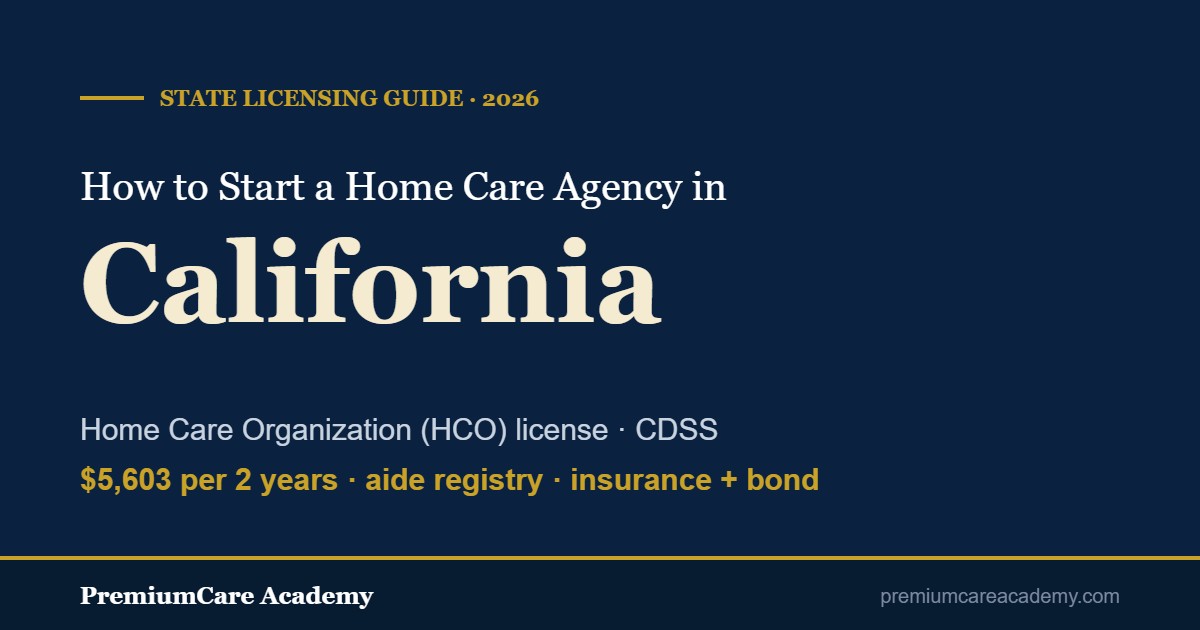
    License nameHome Care Organization (HCO) License
    Issued byCalifornia Department of Social Services (CDSS), Community Care Licensing Division, Home Care Services Branch
    Governing lawHome Care Services Consumer Protection Act (AB 1217), Health & Safety Code §1796.10 and following
    License fee$5,603, nonrefundable, covers 2 years
    RenewalEvery 2 years, $5,603
    Caregiver registrationHome Care Aide Registry, $35 every 2 years
    Insurance$1M per occurrence / $3M aggregate liability, $10,000 dishonesty bond, workers’ comp

    Do you need a license to provide home care in California?

    Yes. Since January 2016, any business that sends caregivers into clients’ homes for pay to help with non-medical needs (bathing, dressing, meals, companionship, errands) must hold an HCO license from CDSS. Medical services such as skilled nursing are a different license from the California Department of Public Health and are not covered here.

    Step-by-step: how to get an HCO license

    1. Form your business entity. California doesn’t require a particular structure. Partnerships, corporations and LLCs file an extra form (HCS 309) and board members must show they understand their duties.
    2. Get your insurance and bond in place. You need proof of general and professional liability coverage of at least $1,000,000 per occurrence and $3,000,000 aggregate, an employee dishonesty bond of at least $10,000, and a workers’ compensation policy covering your aides.
    3. Write your required documents. Personnel policies, job descriptions, a caregiver training plan and a program description. CDSS publishes an HCO inspection checklist (HCS 9201) that shows what they look for.
    4. Complete the application packet. Follow the instructions on form HCS 281. Section A includes HCS 200 (application), HCS 215 (applicant information), HCS 308 (designation of responsibility), HCS 309 (entity details), HCS 402 (dishonesty bond) and HCS 9165 (board statement).
    5. Mail it with the fee. The packet goes by mail to the CDSS Home Care Services Branch in Sacramento with the $5,603 fee.
    6. Fingerprints and orientation. CDSS sends you an HCO number with instructions for Live Scan fingerprinting and the required CDSS orientation.
    7. License decision. Once you are licensed, every caregiver you send out must already be cleared on the Home Care Aide Registry.

    How much does it cost to start a home care agency in California?

    The state fees are only part of it. The fixed items from CDSS:

    • HCO license: $5,603 (nonrefundable, 2 years)
    • Home Care Aide registration: $35 per caregiver, every 2 years
    • Change of location: $100. Change of corporation: $200

    On top of that, budget for liability insurance, the bond, workers’ comp, Live Scan fingerprinting, and enough cash to make payroll before your first client invoices are paid. Insurance and payroll are where most new owners underestimate.

    Caregiver requirements in California

    • Registry clearance before any client contact. Aides apply through the CDSS Guardian portal (form HCS 100), pay $35, and complete Live Scan fingerprinting.
    • Training: 5 hours before the first client (2 hours orientation, 3 hours safety), then 5 hours every year. Both can be done online.
    • TB test within 90 days before hire or 7 days after, repeated at least every 2 years if negative.
    • Coming January 1, 2027: SB 412 (2025) adds required dementia-care training before aides provide services and every year after.

    The state does not require caregivers to be CNAs. My agency hires only CNAs anyway, because families notice the difference and so do referral sources. It is a choice, not a rule.

    How long does it take?

    CDSS does not publish an official processing time. Attorneys who handle HCO applications commonly estimate 3 to 6 months. Incomplete packets are the most common cause of delay.

    Can a non-medical agency get paid by Medi-Cal?

    An HCO license does not enroll you in Medi-Cal. Licensed agencies can contract with Medi-Cal managed care plans to provide the CalAIM Community Supports service “Personal Care and Homemaker Services.” IHSS is a separate, county-run program.

    The mistakes I see most often

    • Filing before insurance and the bond are actually bound, then waiting on paperwork.
    • Treating the policies and training plan as a formality. These are what your inspection is measured against.
    • Planning for the license but not for the first 90 days of payroll.

    Starting in a different state? Compare home care licensing by state.

    Want the full playbook?

    The license is step one. Getting clients, hiring caregivers and running payroll without going broke is the rest. The Home Care Agency Blueprint walks through all of it in 49 lessons, based on how we built and run a licensed California HCO. If you want to start smaller, the Home Care Agency Startup Workbook is $29.99, or see the full syllabus.

    FAQ

    Do I need a nursing license to open a home care agency in California?

    No. CDSS sets no education or clinical requirement for HCO owners. I am not a nurse. You do need to pass a background check and complete the CDSS orientation.

    Can I run a home care agency from home in California?

    The application asks for a physical location and a mailing address. CDSS does not publish detailed office rules, so check your city’s zoning and business-license rules too.

    Do companion-only services need a license?

    If you place caregivers in clients’ homes to provide non-medical services for pay, plan on needing an HCO license. Ask CDSS about your specific model before you start.

    Sources

    This article is general information, not legal advice. Confirm current requirements with CDSS or a licensing attorney before you apply.

    Want help getting licensed in California?

    We write the policy binder California asks for, prepare your HCO license application for you to sign, and answer correction letters until the state decides. The full PremiumCare Academy course is included.

    See my California price or book a free 30-minute call